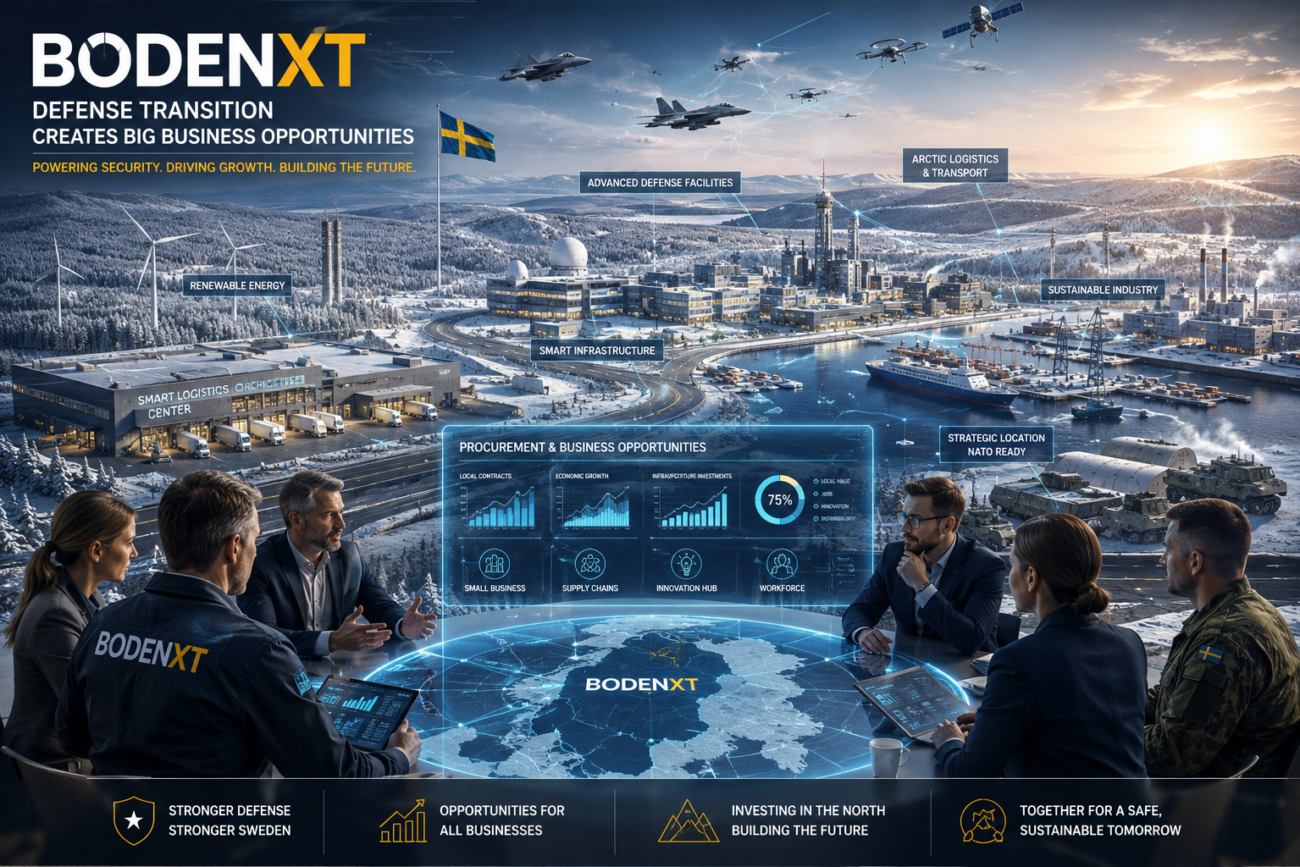
The economic future of northern Sweden is being shaped by two powerful forces: the green industrial transition and a rapidly evolving security landscape. At the center of these developments stands Bodenxt, a platform that brings together businesses, public organizations, researchers, and community leaders to explore growth opportunities in and around Boden. As Sweden strengthens its defense capabilities and expands military infrastructure, local and national companies are discovering new possibilities in procurement, construction, logistics, technology, and support services.
The defense transition taking place in Boden is more than a military expansion. It represents a broader transformation of the regional economy. Increased defense investments create demand for products, services, facilities, transportation networks, housing, and workforce development. Businesses that understand these changing requirements can position themselves for long-term growth.
Boden has historically played an important role in Sweden’s defense strategy. Today, that role is becoming even more significant. With Sweden’s NATO membership, increased military readiness, and growing geopolitical interest in the Arctic region, the city is emerging as a key location for future investments.
This article explores how Bodenxt is helping businesses understand these opportunities, why defense-related growth matters for the local economy, and how companies of all sizes can benefit from this new era of development.
Search Arctic Today
The Arctic region is no longer viewed solely as a remote and sparsely populated area. It has become one of the world’s most strategically important regions. Governments, defense organizations, researchers, and businesses are increasingly focusing on the Arctic because of its natural resources, transportation routes, and geopolitical significance.
As climate conditions change and Arctic shipping routes become more accessible, global powers are paying closer attention to northern regions. This shift has elevated the importance of northern Sweden and particularly the city of Boden. Located in a region that serves as a gateway to the Arctic, Boden is positioned at the intersection of economic development and national security planning.
Through events such as Bodenxt Talks, experts discuss how global developments influence local business opportunities. Defense analysts have highlighted the increasing strategic importance of Arctic infrastructure, transportation networks, communications systems, and logistics capabilities. These factors contribute to a growing need for investments in both military and civilian sectors.
The heightened focus on Arctic security creates opportunities across multiple industries. Construction firms may support new facilities and infrastructure projects. Technology companies can contribute cybersecurity, communications, and digital solutions. Logistics providers can help manage complex supply chains required for defense operations and industrial development.
For businesses seeking future growth markets, understanding Arctic developments is becoming increasingly important. The region’s rising global significance means that organizations capable of delivering reliable products and services may benefit from long-term investment trends.
Bodenxt serves as a valuable platform for helping companies understand these changes. By connecting local entrepreneurs with industry experts and government representatives, the initiative enables businesses to identify emerging opportunities and prepare for future demand.
Why Bodenxt Matters in Sweden’s Defense Expansion
Bodenxt has become an important meeting place for discussing economic growth, innovation, and regional development. The platform helps bridge the gap between businesses and major public-sector investments, particularly those connected to defense and infrastructure.
Sweden’s defense expansion involves more than increasing military personnel. It includes modernizing facilities, expanding operational capabilities, strengthening logistics networks, improving readiness, and investing in technology. These activities generate substantial economic activity that extends beyond the defense sector itself.
Many businesses mistakenly assume that defense-related opportunities are limited to large contractors. In reality, military organizations rely on extensive supply chains involving thousands of suppliers. Services such as maintenance, transportation, food supply, facility management, engineering, training, software development, and environmental services all play essential roles.
Bodenxt helps local businesses understand how procurement processes work and what requirements must be met to participate. Through presentations, networking events, and expert discussions, companies gain valuable insights into future projects and market needs.
Another important aspect of Bodenxt is its focus on collaboration. Economic development often succeeds when businesses, government agencies, educational institutions, and community organizations work together. By fostering dialogue between these groups, the initiative helps create a stronger and more resilient regional economy.
The platform also highlights the relationship between defense investments and broader community benefits. New infrastructure, workforce training programs, housing projects, and business opportunities contribute to regional growth while supporting national security objectives.
As Sweden continues to strengthen its defense capabilities, initiatives like Bodenxt will remain important tools for helping businesses adapt and thrive in a changing environment.
Bring the Arctic to Your Inbox with Our Newsletter
Access to timely information has become a competitive advantage in today’s business environment. Companies that stay informed about regional developments are often better positioned to identify opportunities, manage risks, and make strategic decisions.
A dedicated Arctic-focused newsletter provides valuable updates on defense investments, infrastructure projects, economic development initiatives, policy changes, and industry trends affecting northern Sweden. For businesses operating in or considering expansion into the region, such information can support better planning and decision-making.
The Arctic economy is evolving rapidly. New investments in energy, transportation, defense, mining, technology, and sustainability initiatives are creating opportunities across multiple sectors. Understanding these developments allows companies to anticipate future demand and align their services accordingly.
Newsletters also help businesses track procurement announcements, partnership opportunities, and upcoming events. This information can be especially useful for small and medium-sized enterprises that may not have dedicated teams monitoring industry developments.
In the context of Bodenxt, access to expert insights helps companies understand how local opportunities connect to larger national and international trends. Business leaders can gain perspectives from defense specialists, economic analysts, government officials, and industry experts who regularly contribute to discussions about regional growth.
Regular updates also strengthen business networks. By staying informed about conferences, workshops, and collaborative initiatives, organizations can connect with potential customers, partners, and suppliers. These relationships often play a critical role in securing contracts and expanding market reach.
As Arctic development accelerates, information becomes a strategic resource. Businesses that remain engaged with regional developments are more likely to identify emerging opportunities and respond effectively to changing market conditions.
Economic Impact of Defense Investments in Boden
Defense investments create economic effects that extend far beyond military operations. When governments invest in infrastructure, facilities, equipment, and personnel, these expenditures generate demand across numerous sectors of the economy.
In Boden, the expansion of defense activities is expected to contribute to job creation, increased business activity, and long-term economic growth. Construction projects require contractors, engineers, architects, and suppliers. New personnel create demand for housing, retail services, transportation, education, and healthcare.
The economic benefits are often distributed throughout local supply chains. A major infrastructure project may involve dozens or even hundreds of subcontractors providing specialized products and services. This creates opportunities for businesses of varying sizes and capabilities.
The following table illustrates some of the sectors expected to benefit from defense-related growth in Boden:
| Industry Sector | Potential Opportunities |
| Construction | New facilities, renovations, infrastructure |
| Logistics | Transportation, warehousing, distribution |
| Technology | Cybersecurity, software, communications |
| Food Services | Catering, supply contracts, meal services |
| Property Development | Housing and commercial projects |
| Maintenance | Equipment servicing and facility management |
| Engineering | Design, planning, technical consulting |
| Environmental Services | Sustainability and compliance solutions |
Beyond direct economic activity, defense investments can improve regional competitiveness. Enhanced infrastructure supports both military and civilian needs. Improved transportation networks, communications systems, and public services make the region more attractive to investors and businesses.
These developments contribute to a stronger economic foundation that can support growth across multiple industries for years to come.
Small Business Opportunities in Local Procurement
One of the most important messages emerging from Bodenxt discussions is that small businesses have a meaningful role to play in defense-related procurement.
Many entrepreneurs assume government contracts are reserved for large corporations. While major projects often involve large contractors, smaller companies frequently participate as direct suppliers or subcontractors. In many cases, local businesses possess specialized expertise, local knowledge, and operational flexibility that larger organizations cannot easily replicate.
The growing emphasis on local procurement creates opportunities for businesses across a wide range of industries. Services such as cleaning, maintenance, transportation, catering, landscaping, equipment rental, electrical work, and facility support may all be required as military activities expand.
Success in public procurement often depends on preparation and attention to detail. Companies must understand tender requirements, provide accurate documentation, meet quality standards, and demonstrate their ability to deliver services reliably. Even minor administrative errors can reduce the chances of winning contracts.
For many small businesses, subcontracting can serve as an effective entry point. Working alongside larger contractors allows companies to gain experience, build references, and develop relationships that may lead to future opportunities.
Digital transformation is also creating new possibilities. Technology providers, software developers, cybersecurity firms, and data management specialists can contribute innovative solutions that improve operational efficiency and security.
Businesses that invest in quality management systems, staff training, and regulatory compliance may gain a competitive advantage in procurement processes. Government agencies and defense organizations increasingly value suppliers that demonstrate reliability, professionalism, and long-term commitment.
The shift toward greater local sourcing represents an opportunity for regional businesses to become part of larger supply chains while contributing to economic growth within their communities.
The Future of Boden’s Business Landscape
The future business landscape in Boden is being shaped by the convergence of defense expansion, technological innovation, and sustainable development. These interconnected trends are creating a unique environment where businesses can grow alongside major public and private investments.
One notable factor is the interaction between defense initiatives and the green transition. Northern Sweden has attracted significant attention for renewable energy projects, sustainable industrial development, and climate-focused innovation. When combined with defense-related investments, these developments create a diversified economic ecosystem capable of supporting long-term growth.
Workforce development will play a critical role in this future. As demand for skilled labor increases, educational institutions, employers, and government organizations must collaborate to ensure workers have the skills required by emerging industries.
Technology adoption is expected to accelerate across sectors. Advanced communications systems, artificial intelligence, automation, cybersecurity, and data analytics will become increasingly important in both defense and civilian operations. Businesses that embrace innovation may find new opportunities to compete in regional and national markets.
Collaboration will remain another key success factor. Companies that actively participate in industry networks, knowledge-sharing initiatives, and business development programs are often better positioned to identify opportunities and respond to changing market conditions.
Bodenxt’s role as a connector between stakeholders will likely become even more valuable as these transformations continue. By bringing together experts, businesses, researchers, and policymakers, the platform helps create an environment where innovation and growth can flourish.
The coming years present significant opportunities for organizations willing to adapt, invest, and engage with the region’s evolving economic landscape.
Conclusion
Bodenxt highlights a powerful economic transformation taking place in northern Sweden. As defense expansion, Arctic development, and sustainable industrial growth converge, Boden is emerging as a strategic hub for investment and innovation. The opportunities extend far beyond military operations, creating demand for construction, logistics, technology, maintenance, food services, engineering, and countless supporting industries.
For businesses, the message is clear: preparation, collaboration, and awareness are essential. Companies that understand procurement processes, invest in quality standards, and stay informed about regional developments will be better positioned to benefit from future growth. Small and medium-sized enterprises have particularly strong opportunities to participate through local procurement and subcontracting arrangements.
As Sweden strengthens its defense capabilities and Arctic significance continues to grow, Bodenxt serves as an important platform for connecting businesses with the opportunities that will shape the region’s future. The organizations that engage today may become the key contributors to tomorrow’s economic success.
FAQs
1. What is Bodenxt?
Bodenxt is a business and development initiative that brings together companies, experts, public organizations, and community stakeholders to discuss growth opportunities and regional development in Boden, Sweden.
2. Why is Boden becoming more important strategically?
Boden’s location in northern Sweden and its connection to Arctic security, NATO-related activities, and defense infrastructure make it increasingly important in regional and national planning.
3. Can small businesses participate in defense procurement?
Yes. Small businesses can compete for local contracts, provide specialized services, or participate as subcontractors in larger projects.
4. Which industries benefit most from defense expansion?
Construction, logistics, engineering, technology, maintenance, food services, property development, and environmental services are among the sectors expected to benefit.
5. How can businesses prepare for future opportunities?
Companies should monitor procurement announcements, improve quality assurance processes, invest in workforce development, and actively participate in industry networking events.
